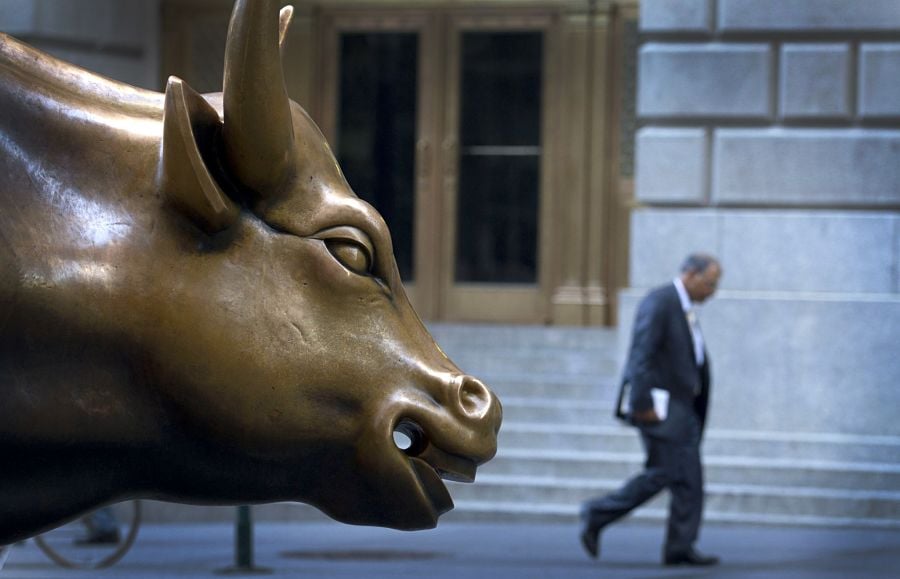
Investors abandon equity mutual funds as the S&P 500 logs a 16% gain.
With the S&P 500 Index up more than 16% from the start of the year, the current bull market is officially the longest on record. But the latest mutual fund flow data suggest retail investors might be getting tired of the run.
This year through April, global equity mutual funds have experienced more than $134 billion worth of net outflows, including more than $56 billion from U.S. mutual funds, according to the Investment Company Institute.
"This continues to be the single most hated and disavowed market of all time," said Paul Schatz, president of Heritage Capital.
"There are an overwhelming number of things to be worried about, so that has the average person pulling money out of the market," Mr. Schatz said. "But the thing is, the things people are worried about are not well-founded, and the market just doesn't care."
At least part of the pullback by retail investors can be attributed to the stock market's sudden decline of 13% during the fourth quarter, said Todd Rosenbluth, director of mutual fund and ETF research at CFRA.
"Investors that got nervous in the fourth quarter and retreated have missed out," he said. "Investors can be very bad at timing, but it is very hard to time the market."
From the March 9, 2009, low through Thursday, the S&P has produced a compound annualized return, including dividends, of nearly 18%.
"Even Warren Buffett isn't getting returns like that," said Howard Silverblatt, senior index analyst at S&P Dow Jones Indices. "You won't get that sitting in CDs."
Mr. Silverblatt believes retail investors should be getting on board the ride being provided by strong economic fundamentals and increasing corporate activity.
"The economy is still doing well, housing is doing well, and interest rates are still at historic lows, which means mortgages will stay low and corporations have easy access to borrowing," he said.
The corporate influence on the markets, Mr. Silverblatt said, is showing up as record-level capital expenditures, stock buybacks and dividends.
"Companies have more money because their taxes are lower," he said. "And, you could argue about the ways corporations are spending their money, but they are spending it, and that is driving the market higher."
While some see the corporate activity as an example of the smart money moving against the grain of retail investors, the corporate spending practices that are driving the market higher could also be viewed as a bearish indicator.
"If a corporation has run out of ideas [on which to spend money] as far as new products or new factories, then that may be a sign of bad times to come," said Kashif Ahmed, president of American Private Wealth.
"I think there is more under the surface," Mr. Ahmed said. "With many politicians, especially those on the left aspiring to move into the Oval Office, coming out with what I consider anti-capitalism or anti-free-market policy proposals like limiting buybacks, corporations may simply be trying to get ahead of any of these potential policy proposals becoming reality."
Mr. Schatz of Heritage Capital also thinks that politics is playing a role in market activity.
"Since the 2016 presidential election, people have been looking for reasons not to be invested, and that's the exact opposite of what a successful investor does," he said. "A successful investor looks for a reason to be invested because the market is positive 70% of the time."