

When Liz Windisch decided to carve out her niche financial-planning focus, she stuck with what she understands: women in their 40s and 50s, an age range generally encompassing Generation X.
“I think Gen X is really overlooked in the financial planning space,” she said. “We get all this information about not just concentrating on baby boomers and don’t forget about the millennials. But Gen Xers are at a really critical place and there’s not a lot of attention paid to them.”
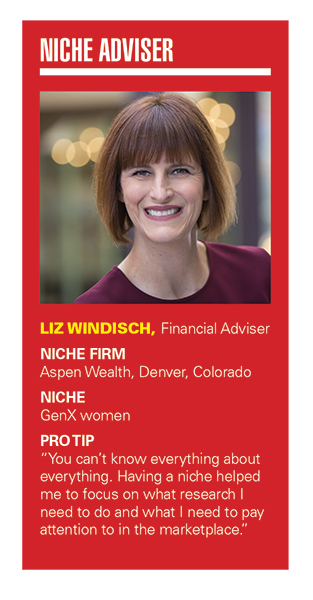
Windisch started establishing her niche after joining Aspen Wealth Management as a financial adviser three years ago.
A career changer who previously worked in parks and recreation administration, Windisch transitioned into financial planning about 17 years ago when she was in her early 30s.
“Financial planning was always a personal interest of mine, but I was just afraid to try it as a career,” she said. “But once I met some other people doing it as a career, I started taking the CFP course work and found out that I loved it.”
While Windisch cut her teeth in the wealth management space as a generalist adviser for two other firms before joining Aspen, the focus on a specific niche is along the lines of where the industry is believed to be heading.
According to a recent report from Inside Information and Dialektic Consulting called New Frontiers in Wealth Management, niche planning practices are the future of financial advice because they help advisers build deeper relationships with subsets of the overall market of potential clients.
When it comes to niche strategies, the report finds the typical advisory firm is missing the mark with a business strategy that is “vaguely defined and the target client is determined largely by asset level.” Geography, which was once a key element of gaining market share, is also overly leveraged by some firms even though technology has made location mostly irrelevant.
Windisch, who fits into the Generation X category of people born between 1965 and 1980, is following a smart strategy of narrowing her market and sticking to it, even if that means turning potential clients away because they don’t fit into her niche.
While her focus is on Gen X women, Windisch does work with male-and-female couples as long as the woman is “at least 50% engaged in the financial decision-making process.”
“About 25% of my clients are couples, and I don’t get a lot of single men coming to me because they probably see my marketing,” she said.
Beyond the specific age group of people in their 40s and 50s, which Windisch believes still allows time to make some prudent retirement planning moves, she thinks women, in general, are “hungry for a true partnership with an adviser, and I really enjoy that.”
“Historically, the relationship between women and financial advisers has been more of a relationship where they’ve been told what to do,” she said. “Many women want to be a partner instead of just being told what to do.”
Challenges specific to Windisch’s niche include planning for longer life expectancies and often not earning as much money as men.
“Women sometimes have to retire later and save more money,” she said. “And because women will usually outlive their husbands, long-term care can be a bigger concern.”
To accommodate the varied needs of her clients and potential clients, Windisch offers hourly rates, but about 80% of her clients are paying asset-based fees.
In terms of marketing to her niche, Windisch writes a blog and publishes a client newsletter, and promotes them on social media like LinkedIn, but she makes it clear that she's "not marketing to the masses.”
“I think my niche is pretty obvious if you follow me on social media or go to my website because I just put that information out there,” she said.
The benefits of a narrow niche practice, she explained, are accepting that, “You can’t know everything about everything. Having a niche helped me to focus on what research I need to do and what I need to pay attention to in the marketplace.”
From a practice management perspective, Windisch is content with the idea that, unless she alters her niche focus, her finite category of Gen X women isn’t something that would likely appeal to a potential buyer or next generation adviser down the road.
“I’ll take my clients with me into retirement,” she said.

Salespeople at the firm often went beyond the matching algorithm to recommend network advisors on its Zoe Wealth platform, according to the regulator.

The Protect College Sports Act would cap school payments and codify NIL rights, with implications for advisors guiding young athletes.

"I know the number that I want to be able to retire on, and now I just want out," says Wilmington Trust's Marguerite Weese, describing a common refrain among business-owner clients.

Bessemer and Brown Brothers Harriman veteran Robert Ludricks III and private markets specialist Olof Akesson join the ultra-high-net-worth push on the East Coast.

765 investors were promised 260% annual returns on truck leases
As AI makes financial information more accessible than ever, Lana Hock explains why human judgment, trust, and empathy remain the qualities clients value most in a financial advisor
Northern Trust’s Ken Lassner shows advisors how to convert volatility into after-tax portfolio gains

