
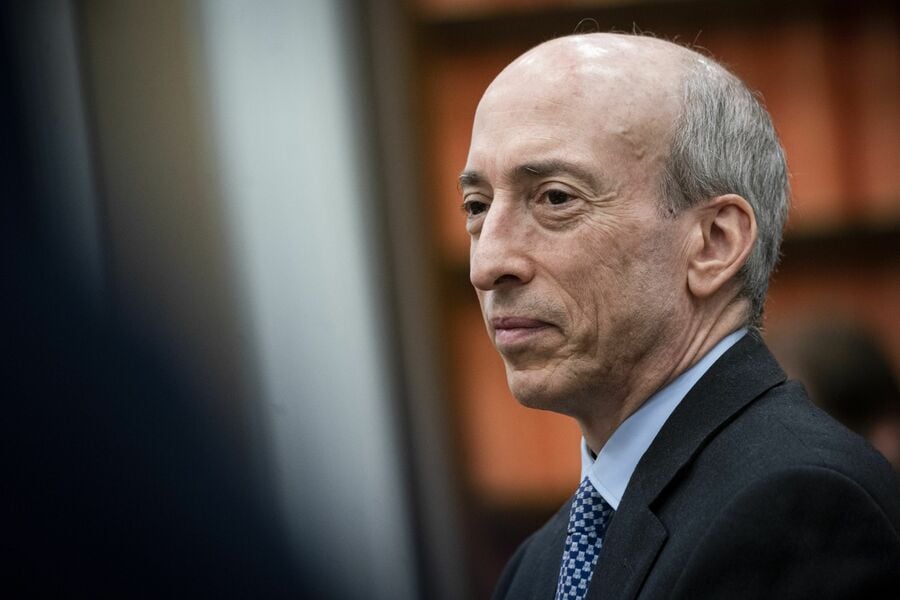
Investors don’t distinguish between investment advisers and brokers, even though they operate under different regulation, SEC Chair Gary Gensler said Wednesday.
Gensler made that assertion in an appearance before the Investment Adviser Association’s Policy and Leadership Forum, an audience that has a professional stake in promoting the fiduciary duty that governs investment advisers and differentiating it from the broker standard of conduct, Regulation Best Interest.
“The American public doesn’t make as much of a distinction as we do in our laws,” Gensler said in a video interview with IAA CEO Karen Barr, who was on stage at the IAA conference at a Washington hotel. “There is to the American public a kind of blurring even though we do have these two laws and important distinctions.”
Barr expressed concern that differences between brokers and advisers are being lost in the way the SEC is implementing Reg BI. In guidance regarding Reg BI compliance on account openings and conflicts of interest, the SEC has emphasized that whether investors are working with advisers or brokers, they should receive advice that is in their best interests.
That approach has caused a neuralgic reaction among fiduciary advocates, who see the adviser standard as tougher than the broker rule on curbing conflicts. Barr pointed out that advisers are fiduciaries throughout their relationship with clients, while brokers must act in clients' best interests only when they’re buying or selling securities and other investments.
Gensler said that as separately managed accounts, online brokerages and cryptocurrencies have proliferated, investors are “swipe left or swipe right,” and aren't paying attention to who’s an adviser or broker. Yet he implied that neither brokers nor advisers should emphasize their revenue goals over their clients’ desire for good investment returns.
“I understand what you’re saying,” Gensler told Barr. “But when somebody only transacts occasionally, each transaction matters a lot.”
Earlier in their conversation, Gensler reiterated that his agenda is focused on making the capital markets more transparent and efficient. One of the ways he’s trying to do that is by reducing the cost of “intermediaries,” a category that includes investment advisers and brokers.
Barr pushed back against the notion that advisers are simply in the middle between stock issuers and investors. She said they help clients with a range of financial needs and challenges, including saving for education and retirement and responding to life events like marriages and divorces.
“They’re not just some middle person,” Barr said. “They are providing a very important service to their [clients], and it should be valued on its own, not just as a connector.”
Gensler agreed that investment advice is a “very valuable thing,” noting that he spent 18 years on Wall Street in an advisory capacity at an investment bank.
“The value of of advice is a very important feature of capital markets, no doubt,” he said. “But Congress gave us a mandate to try to use transparency and competition to promote greater efficiency in the markets.”
Much of the 30-minute conversation focused on Gensler’s agenda, which groups like IAA have called more aggressive than any SEC agenda in recent memory.
Barr pressed Gensler on the challenges advisers face when rulemakings overlap and are implemented simultaneously. She also urged him to ensure that new regulations don’t place an undue burden on small advisory firms.
An experienced and savvy regulator, Gensler played his cards close to his vest. He said the agency listens to public comments from groups like IAA and their members as it works on regulatory proposals.
“Keep engaging with the SEC,” Gensler said.

FINTRX data shows 342 company transactions in the quarter, with wealth management consolidation driving nearly one in seven deals.

State regulators secure $4.4 million from two broker-dealers over unreasonable charges on small-dollar retail equity trades.

New F&G survey finds most pre-retirees are delaying or redesigning retirement, creating fresh planning opportunities for financial advisors.

Focus Partners Wealth’s Jeffrey Levine says a Democratic House or Senate would make new legislation on Trump Accounts much harder to pass

Docupace also rebuilt its wealth operations platform around a single client record, while Focus Financial picks Nevis to bring AI to its advisors.
Knighthead Life entered the market with a competitive MYGA. A strong launch earned advisor confidence and paved the way for FIAs.
As AI makes financial information more accessible than ever, Lana Hock explains why human judgment, trust, and empathy remain the qualities clients value most in a financial advisor

