
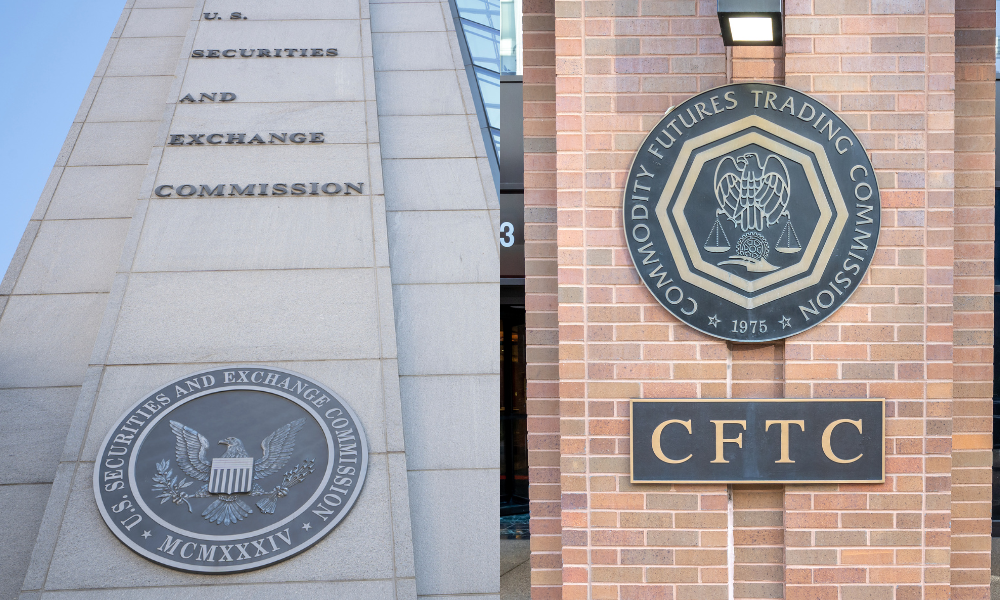
President Donald Trump on Thursday sent the Senate a bipartisan slate of nominees for the Securities and Exchange Commission and the Commodity Futures Trading Commission in a move that could return a Democrat to the SEC's currently undermanned leadership with two Republican commissioners.
For the SEC, the White House named Kristin N. Johnson and Steven Levine. Johnson is a Michigan Democrat who served as a CFTC commissioner under President Joe Biden, while Levine is a Maryland Republican and a senior official on the White House Council of Economic Advisers.
According to the White House nomination notice published on Thursday, Johnson would take the seat previously held by Caroline Crenshaw, for a term ending June 5, 2029. Levine would fill Hester Peirce’s former seat through June 5, 2030.
Before joining the council, Levine was deputy chief of staff to Commissioner Mark Uyeda during Uyeda’s stint as acting chairman early in 2025, Bloomberg reported.
Johnson, who left the CFTC in 2025, brings a background that includes academic posts – including George Washington University Law School – and an earlier role as a vice president at JPMorgan Chase.
If confirmed, the two would be the first Democratic nominees Trump has put forward for either regulator since returning to the White House, according to Bloomberg.
The SEC is designed as a five-member body with no more than three commissioners from one party. Under Chairman Paul Atkins, it has lost that shape over the past year.
Crenshaw, the agency’s last Democrat, left in January after her term expired, leaving an all-Republican leadership to steer markets.
Peirce was the commission’s most prominent crypto advocate and head of its Crypto Task Force. She departed for an academic position on Oct. 2, leaving Atkins and Uyeda as the only sitting commissioners.
Days before Peirce’s exit, the SEC amended its 31-year-old quorum rule, which sets the minimum number of commissioners needed to act. Under the change, a single commissioner can act for the agency when the other sitting member is disqualified from a matter. Critics argued the change could fast-track an RIA performance fee proposal that would let advisors to registered funds charge performance fees of up to 20% of net gains.
The turnover has at the SEC reached the staff level too. Enforcement Director Margaret Ryan resigned in March after roughly six months in the job.
At the CFTC, Trump nominated Nathan Anonick, a Republican and senior counsel on the Senate Agriculture Committee, for a term through June 19, 2031. He also nominated Matthew Rowland, a Democrat who has worked as a CFTC attorney, with the same Senate committee and on Johnson’s staff. Rowland would serve out a term ending April 13, 2028.
CFTC Chairman Michael Selig, who is currently the agency’s only commissioner, called the pair “two strong bipartisan picks” in a post on X.
Both CFTC nominees have worked on digital-asset legislation. Anonick helped shape the Agriculture Committee’s portion of the Digital Asset Market Clarity Act, the bill that would divide crypto oversight between the two regulators.
On Sept. 15, the bill stalled when a Senate procedural vote failed 49-50, falling short of the 60 votes required. Both agencies have since been writing crypto policy under their existing powers.
The administration’s embrace of crypto has drawn growing Democratic resistance amid concerns around the Trump family’s digital-asset businesses. During the Clarity Act debate, Democrats pressed for tougher conflict-of-interest safeguards.
Democratic Senator Elizabeth Warren, who is taking the helm at the Senate Banking Committee in January, is set to focus on prediction market oversight and the Trump family's crypto ventures as part of an agenda that also includes affordability, artificial intelligence, prediction markets, and a looming potential financial crisis.
"Warren is looking to focus on the issues that have been the focus of her career and drove the election outcomes across the country on Tuesday - making life more affordable for families across the country, reining in industries that are raising costs and undermining the financial security of Americans, and rooting out corruption," an aide to the Warren banking committee told The Block, a crypto news outlet.

Record quarterly sales and 450 advisor hires in 18 months signal a wealth management transformation underway at Prudential

From managing embedded gains to diversifying concentrated wealth, NTAM's Ken Lassner examines how technology is making individualized portfolio construction more practical for advisors.

Thrivent Investment Management Inc. in May fired Nicholas Hale, according to his BrokerCheck profile.

About 70 bank and credit union advisors move to the Raymond James platform, while a $480M New Jersey team goes independent with LPL

The best tax plan asks not only how much a client could save, but what they would have to give up to save it.
Growing wealth, evolving priorities, and untapped opportunities are reshaping how women approach long-term investing.
Knighthead Life entered the market with a competitive MYGA. A strong launch earned advisor confidence and paved the way for FIAs.

