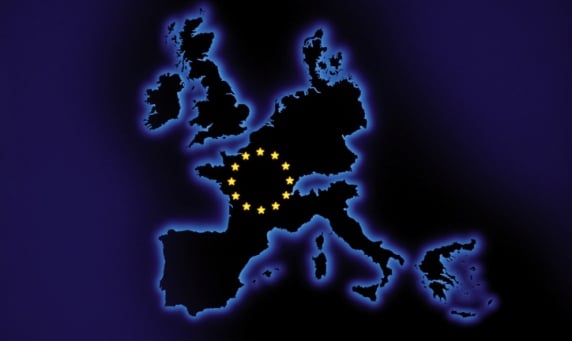
Although U.S. equity markets showed approval Friday for the latest efforts by European leaders to shore up financial support for some of the weaker eurozone countries, market watchers remain cautious and are quick to point out that there will be no easy fix for the financial challenges facing the world's second-largest economic region.
“We know that Europe will stay in a
recession for maybe the next two years because they will be so focused on the fiscal crisis that they won't be able to focus on growth,” said Rob Robis, co-manager of the $1.5 billion ING Global Bond Fund.
As European politicians and bankers scramble to find a way to help countries such as Greece, Italy, Portugal and Spain get their fiscal houses in order without violating the strict European Union restrictions on bailouts and quantitative easing, U.S. equity markets likely will “move in a sideways pattern until we get more information,” he said.
“This is certainly not the best situation for U.S. markets,” Mr. Robis said. “There will be less appetite for risk.”
As European Union leaders pulled an all-nighter Thursday to try to hash out an agreement that likely would depend on some support from the International Monetary Fund, the impact on the financial markets remained extremely dynamic, according to Quincy Krosby, market strategist for
Prudential Financial Inc.
“Approximately 20% of the S&P 500's profits come from the eurozone, which illustrates the interconnectedness of the global markets,” she said. “It won't be until after we see the earnings from the first and second quarters of next year that we will have a clearer sense of the impact.”
SILVER LINING?
In the meantime, Ms. Krosby is focused on finding the silver lining among the dark clouds hanging over Europe.
“Globally, rates are coming down, and it's clear that China will also probably be cutting interest rates, and that should lead to more rate cuts by the European Central Bank,” she said.
The monetary policies, in the form of rate cuts, combined with some fiscal tightening from political leaders, create a “backdrop that typically leads to stronger equity markets and stronger economic growth,” Ms. Krosby said.
“It has to work its way into the system, but right now, you have almost simultaneous rate cuts and some fiscal stimulus,” she said. “There's always an upside.”
Part of what makes the situation in Europe so uncertain, according to Ms. Krosby, is that the markets have taken over control, and the politicians are having a difficult time keeping up.
“The markets want a tight fiscal plan where there is a concrete mechanism for enforcement of budget and fiscal austerity,” she said. “So right now, the markets are in control, and the policymakers have to try and buy some time by placating the markets.”
If nothing else, it is believed that the crisis in Europe could be enough to force politicians to take decisive action on spending patterns.
“The market is telling us they need to take some action, and that's not a great surprise,” said Nigel Emmett, client portfolio manager at J.P. Morgan Asset Management.
“The markets are looking for control, and hopefully, this will force European leaders to understand that they're on the precipice,” he said. “Nothing is ever guaranteed, but politicians, when their backs are against the wall, will ultimately have to make the right decision.”