
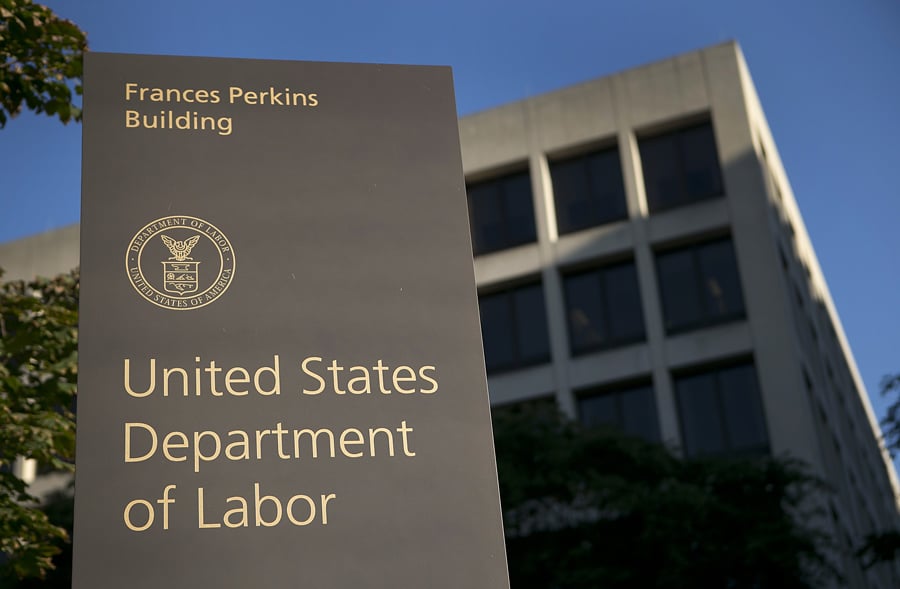
The DOL issued guidance last week about the fiduciary implications of rollover recommendations – but a set of questions it published the same day for account holders could create problems for some advisers.
The regulator last Tuesday published a set of answers to frequently asked questions about part of the Trump-era fiduciary rule, the prohibited transaction exemption dubbed Improving Investment Advice for Workers & Retirees. The guidance clarified that a recommendation to roll funds from an employer-sponsored retirement plan to an individual retirement account can represent the beginning of an ongoing fiduciary relationship between an adviser and a client. In February, the DOL announced that it would not seek to halt or overturn the Trump-era rules that were finalized late last year, although the agency said it would soon issue guidance and could later make changes to the rules.
But along with that recent set of answers to FAQs, the Department of Labor also published a list of questions for retirement account holders to ask advisers.
Among those questions are:
“Are you a fiduciary under the federal laws specifically applicable to retirement accounts?”
“Can I have a written statement that you are a fiduciary under the federal laws specifically applicable to retirement accounts … when you make investment recommendations to me for my retirement accounts? If not, why not?”
And:
“Are you and your firm complying with the DOL’s exemption? If you are not relying on the exemption, are you relying on another exemption previously issued by the Department, or do you believe that you do not have any relevant conflicts of interest?”
The timing of those questions is not great for brokers relying on the DOL’s temporary enforcement policy until Dec. 20, the compliance deadline for the new rules, said Jason Roberts, CEO of the Pension Resource Institute.
“It’s the unintended consequences here that got my attention,” Roberts said. “A lot of firms are not in a position to just flip the switch and say we’re fully compliant with [prohibited transaction exemption] 2020-02.”
Even if firms plan to rely on the exemption, few have likely updated their policies and procedures to reflect that, he said. Doing that before it is officially required can be a regulatory risk, so most firms wait until they must, he said. Regulators and litigators can scrutinize firms for failing to follow their own procedures, even if the procedures are more stringent than what is required under current law.
And because of that, telling a client, especially in writing, that the firm is relying on the exemption could be a big problem, he said. Answering affirmatively, when policies haven’t been updated, could mean that an adviser is misrepresenting herself or himself, he said.
“Generally, the rule is you don’t put things in your policies and procedures that you don’t have to,” he said.
The DOL’s temporary enforcement policy was issued in 2018, following the Obama-era fiduciary rule being vacated in court. Under that policy, effective until late December, firms do no have to give written notification of their fiduciary relationships with clients, but they need to show they have taken steps to comply in good faith with impartial conduct standards and work in a client’s best interest.
“In working with broker-dealers and investment advisers, my experience is that, so far, all of my clients are going to rely on the DOL’s non-enforcement policy until Dec. 20,” Fred Reish, partner at Faegre Drinker, wrote in an email. “That means that they will be complying with the Impartial Conduct Standards until then. That will give them time to develop the practice, policies and procedures needed for compliance with all of the conditions in PTE 2020-02.”
Reish said he was unaware of any broker-dealer or investment adviser that has processes and policies for complying with the new exemption. “In fact, they are months away from that,” he said.
Most RIAs that recommend rollovers will likely need to rely on the new exemption, but many are unaware they will need to do anything differently than they do currently, Roberts said. The rules finalized late last year surprised many in the financial services industry, as the DOL withdrew a critical 2005 advisory opinion, indicating that it would view rollover recommendations as the beginning of an advice relationship.
“A lot of investment advisers are starting from ground zero on this,” he said. “Even for those paying attention, it’s a bit unfair to expect them to have those safeguards [and] the conditions for the exemption … in place, such that they can answer these questions that investors are likely now asking.”

Also, Orion has added BlackRock, Fidelity, and Vanguard to its custom portfolios suite, and RedBlack has set up a new headquarters after crossing a trillion-dollar milestone.

Also, New York-based Legacy Edge Advisors names its first-ever CEO, while Novare Capital Management hires a Vanguard veteran with a multigenerational planning focus.

Asset managers are racing to bring private market products to retirement plans, but cost and liquidity concerns linger.

Treasury's latest tax-exemption crackdown on private schools lands in the wake of a separate push to restrict refundable credits for some immigrant filers.

Workforce trust measures predicted which companies came out ahead during COVID-19. The same dynamic may now be playing out across the AI transition — and the data suggests the spread could be just as wide.
Northern Trust’s Ken Lassner shows advisors how to convert volatility into after-tax portfolio gains
Dan Biagini of American Equity says the steady decline of pensions, longer lifespans and a reset in interest rates are rewriting how advisors build retirement income

