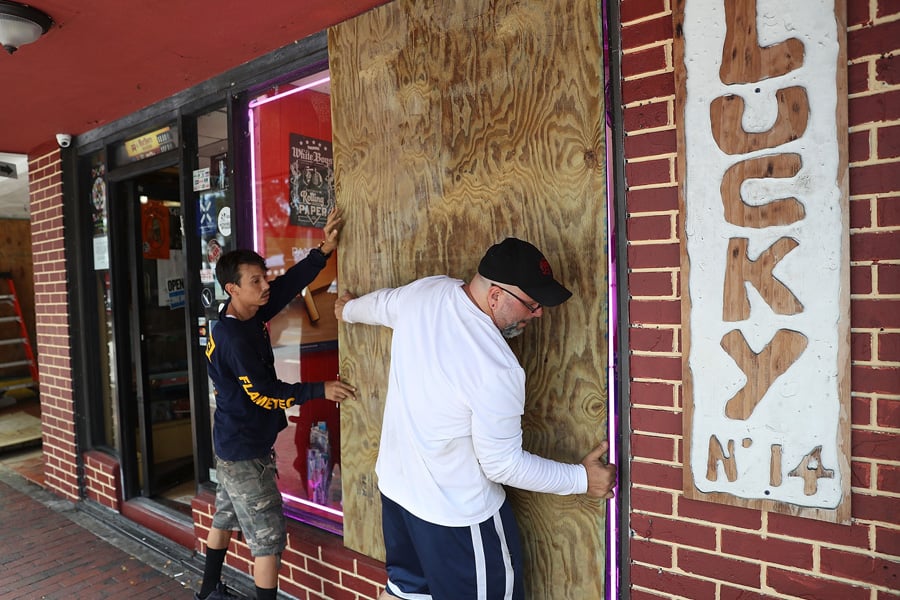
As Hurricane Florence bears down on a large swath of the southeastern United States, financial advisers are heading for shelter and appreciating the increasingly virtual nature of the financial services industry.
Jason Carroll, chief executive of Wilmington, N.C.-based
Live Oak Private Wealth, who has already relocated his family 300 miles southwest of the coastal town to Spartanburg, S.C., said it is "business as usual" for the advisory firm.
"We started our disaster preparedness a week ago, and now we're all up and working," he said.
Even though Wilmington is directly in the current path of what could be the worst storm to hit the Carolinas in at least two decades, Mr. Carroll said that client data are safe and clients can still access their accounts and conduct business with financial representatives.
The more than 500 people working at the advisory firm and the affiliated Live Oak Bank have all been sent to prepare their own homes and take care of their families, Mr. Carroll said.
"They're saying southeast North Carolina might never be the same after this storm, so I don't know what to expect, but I'd like to say that we're going to be there accepting all comers and offering help," he said.
The latest weather reports show the hurricane slowing as it nears landfall, which is expected on Saturday.
Citing the potential for a
13-foot ocean surge and torrential rains, FEMA associate director Jeff Byard was quoted comparing the storm to a "Mike Tyson punch on the Carolinas" and said, "This is not going to be a glancing blow."
Matthew Stevens, a wealth adviser at The Wealth Plan Co. in Wilmington, evacuated his family to Atlanta Wednesday, realizing that he might return home to a completely devastated hometown after what is expected to be up to 72 hours of hurricane-force winds.
But physical property damage aside, Mr. Stevens said his clients, many of whom live in Wilmington, have been assured that it is business as usual as long as he has access to the internet and electricity.
"We sent out communications to clients to let them know we were closing the office and that we're implementing our disaster contingency plan," he said. "That basically means everyone scatters and gets to safety. We don't have any paper files in the office. All software is cloud-based and we all have laptops, and our phone system is Voice over [Internet Protocol], which means somebody could call me and they wouldn't even know if I was in the office or not."
In Raleigh, N.C., where the storm is expected to dump between two and five feet of rain amid high winds, Nina O'Neal, partner at Archer Investment Management, said clients have already been assured that their data and investments are secure.
"Even if right this minute I could never again walk into my office, everything is cloud-based and backed up," Ms. O'Neal said. "The cloud-based ability is a sleep-at-night benefit. As long as I have power, I can operate from anywhere."
Pam Horack, owner of Pathfinder Planning in Charlotte, N.C., said even though she's three hours from the coast, she is bracing for high winds and flooding. But her planning business is as secure as it would be on a calm sunny day.
"People are evacuating and battening down, and even in this area, they're running out of bread and milk in the stores," she said. "But with our contingency plan for the business, we can easily move to a new location and turn things on and be back in business."
Cloud-based
data storage and disaster recovery systems are part of the response to the
increased regulatory focus on business continuity plans that gained traction after Hurricane Harvey hit Texas last year.
Scott Bishop, executive vice president of
financial planning at STA Wealth Management in Houston, wrote a crisis guide for financial advisers based on
his experiences during the Category 4 hurricane that hit Houston last August.
"Before the storm hit here, we sent out emails to our clients letting them know of our disaster recovery plan, and we gave out the cellphone numbers of the partners," he said.
Advisers recommend taking pictures and videos of homes and businesses prior to the storm to help with insurance claims.
Mr. Bishop said advisers will also need to bone up on insurance laws and the tax deductibility of disaster relief benefits, as well as provisions that are typically passed in the wake of natural disasters.