
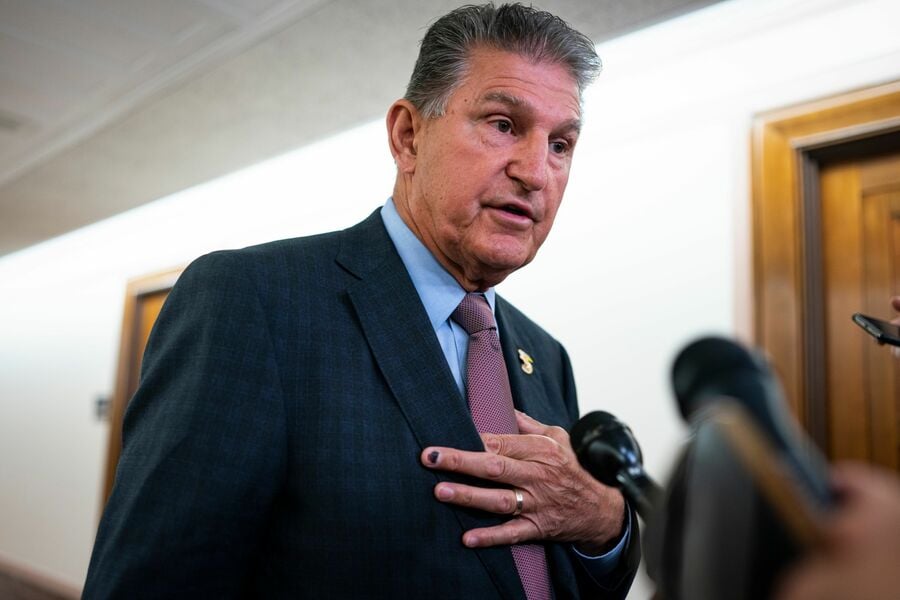
Sen. Joe Manchin, the West Virginia Democrat at the center of negotiations over an economic policy bill, said he opposes changes to the state and local tax deduction, dealing a blow to House Democrats seeking to expand the write-off.
“Our tax code should not favor red-state or blue-state elites with loopholes like SALT,” Manchin said in a statement Wednesday, using the acronym for the tax break. A deal later announced between Manchin and Senate Majority Leader Chuck Schumer on a fiscal package that spans tax, climate and health care measures also omitted any SALT cap expansion.
Excluding an increase of the $10,000 SALT deduction threatens to cause problems with several House Democrats who’ve said their support of any tax-code changes is contingent on raising the cap. The write-off is politically important in high-tax areas including New York, New Jersey and California.
Still, Democratic Rep. Tom Suozzi of New York, one of the biggest advocates for SALT expansion in the House, didn’t immediately reject the Manchin-Schumer deal.
“I don’t think they are touching the individual tax code. I have to study it,” Suozzi said.
Another advocate, Josh Gottheimer of New Jersey, similarly said he couldn’t yet say if he would support the Manchin-Schumer agreement without adding SALT.
“I’ve got to understand the impact that has on families in my district,” Gottheimer told reporters shortly after the deal became public. “Until I see specifics, it’s hard to know, because SALT has always been about total impact of families in my district.”
Francisco Pelayo, a spokesman for Sen. Bob Menendez, a New Jersey Democrat who’s also pressed for SALT cap expansion, said Menendez is looking into the details of the bill.
“While he’s pleased to see that there may be an opportunity to pass a broader package that includes climate and tax provisions, in addition to health care, there are issues impacting New Jersey families that should be addressed, namely lifting the SALT cap,” Pelayo said in a statement.
Manchin — whose vote is vital in the 50-50 Senate — called for a focus in the bill on “closing unfair loopholes like carried interest,” a reference to a tax break used by hedge fund managers.
He also backed a 15% minimum tax for the largest U.S. companies and expanded funding for the Internal Revenue Service.
Democrats can’t lose any votes in the Senate and can only afford a few defectors in the House, given united Republican opposition to the fiscal package.
House Ways and Means Committee Chair Richard Neal warned that not having a SALT cap increase in the bill “is going to cause problems for some of our members over here.”

The $100B-plus mega-RIA is folding custom portfolios, daily tax-loss harvesting and unified managed accounts into its Aspen advisor tech platform

From using projects as strategic thinking exercises to real-world challenges as problem-solving exercises, indie firms can make for more powerful talent incubators.

New BCG research names financial services among the world's most AI-exposed industries and the US as a top-tier AI economy.

Rockefeller Capital Management's Mallory Findley on how avoiding conversations risks derailing even the best-laid estate plans.

New Empower research reveals a "retirement drift" problem that hands financial advisors a direct opening to add client value.
Knighthead Life entered the market with a competitive MYGA. A strong launch earned advisor confidence and paved the way for FIAs.
As AI makes financial information more accessible than ever, Lana Hock explains why human judgment, trust, and empathy remain the qualities clients value most in a financial advisor

