
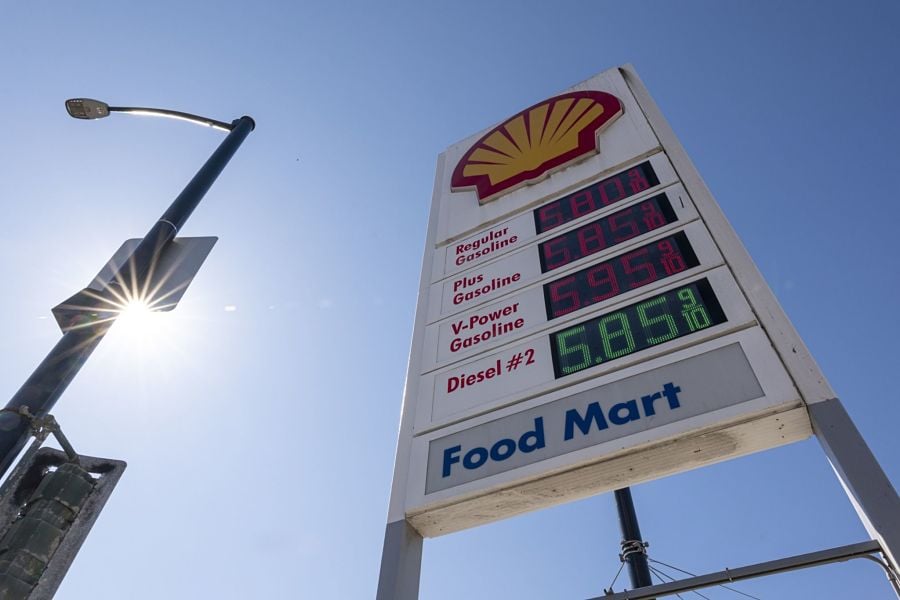
As the war between Russia and Ukraine rolls into its second week, the ripple effects of the economic sanctions against Russia are pushing oil prices higher and giving investors a chance to hedge the falling equity markets.
Crude oil prices, which had already climbded the inflation ladder to nearly $100 a barrel, could be heading toward $150 or $200, according to some market watchers.
So far this year, the spike in oil prices has been a boon for investors in select exchange-traded funds.
The ProShares Ultra Bloomberg Crude Oil ETF (UCO) is up more than 36% this year, Energy Select Sector SPDR ETF (XLE) is up more than 23%, United States Oil Fund (USO) is up 17% and VanEck Oil Services ETF (OIH) is up nearly 29%. Meanwhile, the S&P 500 Index is down 6% over the same period.
Peter Griscom, founder and chief executive of Tradefluence, a peer-to-peer platform that identifies investing trends, says the platform indicates a six-to-nine month run for the current oil market rally.
“We know that with Covid affecting demand for oil, a lot of wells were idled and now have to be pulled back online, which is leading to the rise in oil prices last year and so far this year,” Griscom said. “I don’t see why we wouldn’t see oil prices go to potentially $200 a barrel. Right now, we’re seeing people buying oil exposure as a hedge against broader market risk.”
Terry Sawchuk, CEO of Sawchuk Wealth, has a similarly bullish outlook on oil prices.
“At the height of Covid, there was a short stretch where oil went negative and companies cut way back on production. Now you have a supply constraint,” Sawchuk said. “We were on a trajectory for $5 gasoline before Ukraine, and now we’re on a path to $6 or $7 a gallon for gas. If this war in Ukraine doesn’t resolve itself in short order, we could see oil push $150 a barrel, and that’s a recession starter. This is a combination of restricted supply, bad government policy, and geopolitical turmoil.”
Stewart Glickman, energy equity analyst at CFRA, concurs about the supply issues and bad government policy affecting oil, but he describes forecasts of $150 or $200 oil as “hyperbole.”
Citing the growing list of sanctions against Russia following its invasion of Ukraine, Glickman said global enforcement is getting stronger but there has yet to be any formal action limiting Russia’s distribution of about 12% of global crude oil supply.
“Russia is still supplying oil and no one has included crude oil on the list of things being sanctioned,” Glickman said, adding that sanctions related to crude oil and natural gas would come toward the end of the list of possible actions, given the pain such sanctions would inflict on the U.S.
The thicker type of crude oil produced by Russia to make diesel fuel is still being imported to the U.S., according to Glickman, because the U.S. doesn’t have a lot of options for that type of oil.
“In the past we imported the thicker oil from Venezuela, but we sanctioned them,” he said. “And Mexico has production issues, so that leaves Canada, which is already our largest [source] ahead of Russia, but Biden’s first move when he got into office was to cancel the permits for the Keystone XL pipeline. Now more crude will have to be transported by rail or truck from Canada to replace the crude we’re getting now getting from Russia.”
Paul Schatz, president of Heritage Capital, also doubts that the price of oil is on a runaway trajectory at this point.
“Oil looks like it’s peaking, at least in the short term,” Schatz said. “And the energy stocks are underperforming the commodity. The time to buy oil was November 2021 and almost any time in 2020, especially when it went negative. Now the market is fraught with risk and latecomers.”
Without calling an official top to the price of oil, Glickman believes market forces will prevent it from spiking much beyond $100 a barrel.
He said the increased sanctions on Russia will likely force it to sell oil to China at discounted prices, which would put downward pressure on the price of the commodity globally.
“I don’t think we’ll get to $150 a barrel,” Glickman said. “If oil gets above $125, I do worry that it tips the global economy into recession and back to a 2008-2009 situation, with oil dropping to $30. Nobody wants that.”

The financial advice industry has been facing inquiries into its cash sweep programs for years now.

Investor money allegedly went to strip clubs, exotic cars, and landscaping

Procyon adds $415 million in assets under management in New Jersey while Savant picks up a $213 million Southern California planning firm

With a growing number of real estate-rich Baby Boomers aging into retirement, some advisors may be failing to consider all the options available for those clients' assets.

Cornerstone Advisors study reveals compliance bottlenecks stall campaigns weeks after customer opportunities close.
As AI makes financial information more accessible than ever, Lana Hock explains why human judgment, trust, and empathy remain the qualities clients value most in a financial advisor
Northern Trust’s Ken Lassner shows advisors how to convert volatility into after-tax portfolio gains

