
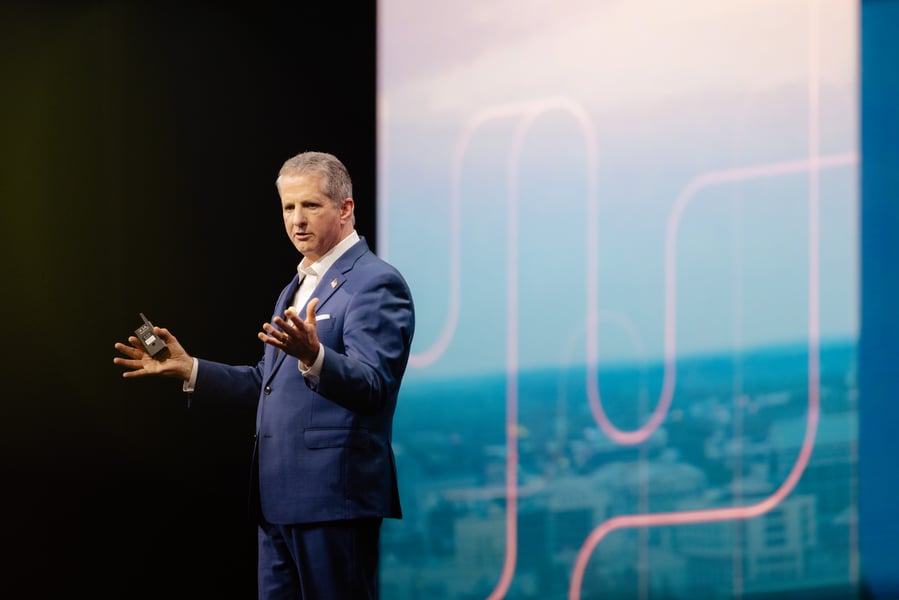
As LPL Financial finishes moving Commonwealth advisors onto its platform, Osaic CEO Jamie Price says LPL's retention figures have been propped up by market gains, and that actual retention of Commonwealth assets LPL kept was “much lower.”
LPL set a 90% retention target when it announced at the end of March 2025 that it was acquiring Commonwealth Financial Network, then home to about 2,900 advisors overseeing roughly $285 billion, for $2.7 billion in cash. LPL kept that target through the summer of 2026, even as CEO Rich Steinmeier told analysts in April and again in July that asset retention was running in the mid-80s.
Then on LPL’s Oct. 27 third-quarter earnings call, Steinmeier said expected “final asset retention” from Commonwealth advisors was approximately 83%. In an interview with InvestmentNews, the CEO of competing independent broker-dealer Osaic has questioned the math and ambiguity behind LPL’s retention claims.
“I think what's interesting about the third-quarter earnings, LPL's, [is] it's not like from the second quarter to the third quarter they went from 90% to 83,” said Price. “They've known the number for longer, which is why I think they got in a little bit of trouble with their stock price. It's because you don't have one quarter, all the sudden, we were at 90, 90, 90, and then oh, in one quarter we dropped to 83 [percent].”
LPL had publicly put Commonwealth retention in the mid-80s since April 2026, while keeping its 90% target in its earnings releases. On the October call, Steinmeier attributed the final step down to Commonwealth advisors who had signed with LPL and then changed course. “We just had a small number of advisors that had signed decide to – not to stay, right,” he said. “So it’s as simple as that, that brought us down to 83%.”
Price spoke to InvestmentNews at last week’s ConnectED conference hosted by Osaic in Atlanta. As Price points out, Steinmeier initially referred to advisor headcount when describing LPL’s goals for Commonwealth retention. By early 2026, LPL’s earnings releases framed the goal as asset retention. By switching the measure to assets rather than advisor headcount, Price says, LPL’s retention figure has been inflated by market gains.
“We happen to know from very good sources how many advisors have left. They've been tracking from day one, when they closed the deal, that they would keep 90% of the assets and advisors,” said Price. “Then they [LPL] changed the narrative to we were going to retain 90% of the assets, and the reported assets at 90% that they were talking about included all the market growth for the last 16 months. It didn't include the day they wrote the deal and underwrote the model. It includes market growth.”
On LPL’s Q2 2025 earnings call, Steinmeier described the Commonwealth retention target in terms of advisors.
“We continue to feel confident about our ability to capture 90%, which does mean we understand that 10% of the advisors will make a different choice and go somewhere else,” Steinmeier said.
A January 2026 report from Muriel Consulting showed that 653 advisors left Commonwealth since news of its sale to LPL, which put LPL at a 77.5% headcount retention rate of advisors.
"It includes market growth, and so we knew that the actual number — the Commonwealth advisors' assets they bought on day one, [excluding] the market growth — was going to be much lower," Price told InvestmentNews. "It's not their fault, by the way. If we were going to do the same deal, I don't think we necessarily would have had any different outcome, candidly."
InvestmentNews reported last year that Raymond James finished second to LPL Financial in the bidding for Commonwealth. In last week’s interview at ConnectED, Price alluded to Osaic also being part of the bidding process for Commonwealth before its sale to LPL.
“If you were going to buy that company [Commonwealth] and give the owners what they wanted out of it, and as the price tag kept going up, going up, and going up, you had to decide, look, we're going to have to pay for it,” said Price.
“Every time we looked at that, we took our retention rate that we thought would happen [and moved it] lower and lower and lower and lower and lower. Well, LPL went in with the highest offer that they [Commonwealth] got, with a 90% retention in their model, which we thought was impossible. Turns out we were right,” Price added.
LPL conducted layoffs to back-office Commonwealth staff in July. According to Price, part of LPL’s challenge in keeping Commonwealth advisors was that before the blockbuster sale, Commonwealth recruiters described its firm as being the “antithesis of LPL,” given LPL's status as the industry’s biggest consolidator. Commonwealth, by contrast, was a boutique firm known for elite advisor service and satisfaction.
“If you look at all the Commonwealth recruiting pitches, which we have—our advisors have gotten over the years from Commonwealth—there's a page in the recruiting pitch that they are the opposite and the antithesis of LPL. I mean, they've been selling this as a cultural thing for a number of years. So it was tough, I think from the day one going in. That doesn't mean they couldn't have underwritten the thing at 75 [percent retention], and been totally okay.”
Price, whose Osaic network spans over 10,000 advisors, added that any move to buy Commonwealth would effectively “destroy their culture” of the Massachusetts-based independent broker-dealer.
“I think anybody that was looking at Commonwealth from a distance or very closely, so just put it out there,” said Price. “In order to do that deal and pay what ultimately was going to need to be paid, you were going to have to destroy their culture. Because in order to pay for it, you were going to have to take costs out that supported that culture in a way that I think was one of the best cultural companies built for advisor satisfaction by far, but it came with a cost.”
LPL’s total recruiting has also cooled. The firm brought in $24 billion in recruited assets in the third quarter of 2026, down 26% from a year earlier, according to its Oct. 27 earnings release. It added a net 122 advisors in the quarter, down from 331 in the second quarter, bringing its headcount to 32,597.
In making a hypothetical acquisition for Commonwealth, Price says that Osaic never would have gone the LPL route of announcing their retention targets.
“We would definitely not have announced 90% to the street,” said Price. “Now they're [LPL is] big enough, over time, it's not going to matter. The street doesn't like it, but I think it's a lesson on really understanding. We've done a lot of M&A as a company, a lot more than anybody that we compete against, and you just have to get really good at these things and be very honest with yourself about what the reality is going to be.”
As of writing this story on Nov. 16, the share price of LPL Financial is down roughly 19% year-to-date. Wolfe Research analyst Steven Chubak agrees with Price’s assessment that it was a mistake for LPL to ever announce retention targets from its Commonwealth transaction.
“In hindsight, LPLA should not have committed to a 90% target at the onset, and it felt increasingly out of reach as the Commonwealth deal sparked an aggressive recruiting war,” Chubak wrote in a Nov. 1 research note. “Shortly after the announcement, TA (transition assistance) rates spiked dramatically (>50% increase, we est.), with RJF / Cetera / Kestra reaping the biggest recruiting gains among Commonwealth advisors, and retention ultimately missed the target.”
In a statement Sunday evening, LPL called the conversion of Commonwealth advisors “the largest in LPL’s history” and “a defining milestone in the partnership of our two firms.” But after converting over the weekend, one Commonwealth advisor privately told InvestmentNews they are “waiting for the assets to show up in the system. Even with all the work done beforehand, this is still a bit stressful.” The Osaic CEO warned that such conversions come at a price for advisors.
“No matter how good you are, advisors don't like change. And if you're going to have to do certain things to make the math work, you have to do certain things to make the math work. It just is what it is,” said Price. “I think they [LPL] got caught a little flat-footed thinking that they could do what they thought they could do, and we always thought this is going to be a tall order.”

80% of Baby Boomers prefer guaranteed income over growth investments, yet only 17% hold an annuity, leaving protection gaps for financial advisors to close

“Even with all the work done before hand, this is still a bit stressful,” one advisor said.

Richmond-based RIA lands a 45-year-old North Carolina wealth management team as small-firm acquisitions slow nationwide

Drawing from Form 5500 filings, the platform scores 780,000 retirement plans and maps warm introductions as advisors chase the DC-to-wealth bridge

Kate Maier of Wealth Enhancement explains why UHNW clients aren’t waiting until death to give.
Growing wealth, evolving priorities, and untapped opportunities are reshaping how women approach long-term investing.
Knighthead Life entered the market with a competitive MYGA. A strong launch earned advisor confidence and paved the way for FIAs.

