

After almost eight years of watching a stream of financial advisors move to competitors, Wells Fargo Advisors appears to have staunched the bleeding of its advisor workforce.
InvestmentNews data for last year show net losses of 153 financial advisors at Wells Fargo Clearing Services, the broker-dealer for the employee, private client group, and just eight at its independent group, Wells Fargo Advisors Financial Network.
The net losses of financial advisors at Wells Fargo have decreased substantially over the past couple of years. In 2021, the private client group saw a net loss of 1,012 financial advisors and Financial Network, or FiNet, saw a net loss of 69, according to InvestmentNews.
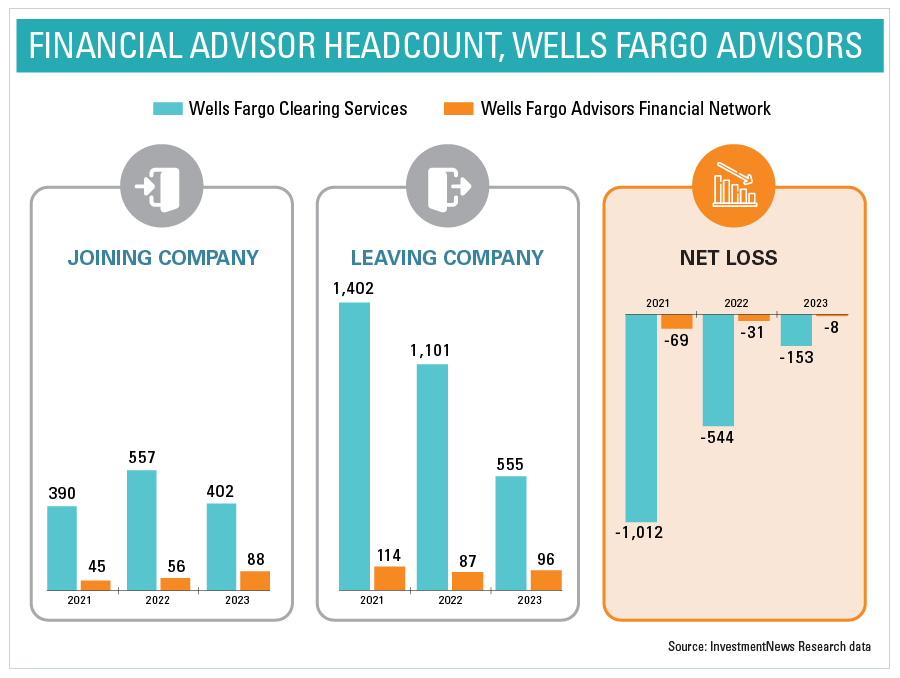
Wells Fargo senior executives are pointing to the return to normal at Wells Fargo Advisors, which has overhauled its management in the past few years and focused on its independent broker business at FiNet.
"We’re back to more normal, or maybe slightly below normal, attrition levels across the [financial advisor] business, which is good," CEO Charles Scharf said during a conference call Friday morning after the bank reported its first-quarter earnings. He had been asked the kinds of financial advisors the firm had been recruiting.
"And we’re feeling very good about our ability to recruit high-quality advisors, and so I think that trend you saw a couple of years ago is definitely different," Scharf added. He did not give details about the numbers of financial advisors Wells was recruiting or losing to competitors.
"If you go back a couple years ago, you definitely saw some decline that we were seeing in advisor workforce," Scharf said. But Wealth and Investment Management CEO Barry Sommers "and team have been working really hard to not only stem some of the attrition but to really ramp up the recruiting again, and I think we’re starting to see some of that come through."
"We’ve recruited some of the biggest teams in the country that have traded over the past year and a half," said chief financial officer Michael Santomassimo. "These are people who wouldn’t have come to Wells Fargo before that, because of the issues. They chose to come here because of our capabilities, not because of what we were willing to pay them.
"There’s no doubt the trajectory we have with our FA population today is very different than several years ago," Santomassimo said.
2016 was the annus horribilis for the bank, Wells Fargo & Co. Inc., which was rocked by revelations that bank employees had secretly created millions of unauthorized accounts in the names of customers without their consent. The bank was fined $185 million and then-CEO John Stumpf resigned abruptly.
That damage to the bank's reputation spilled over into the financial advisor group, which is part of the bank's Wealth and Investment Management division, called WIM internally. At the time of the bank scandals, Wells Fargo Advisors reported more than 15,000 financial advisors across its multiple business lines.
Like its Wall Street wirehouse competitors, Wells Fargo Advisors no longer reports a count of its financial advisors. In January 2023, the last time the bank reported an advisor head count, the tally was close to 12,000. That means roughly 20% of Wells Fargo's financial advisors had either left or retired over a seven-year span.
One senior industry executive, who asked to speak confidentially to InvestmentNews, said there has been less movement of financial advisors in general the past couple years, which may have helped Wells Fargo stabilize its network of advisors.
"If there's a great year in the stock market like last year, or a terrible one in 2022, that seems to slow down brokers moving and may have benefited Wells Fargo," the executive said.
The bank's WIM group reported first-quarter total revenue of $3.7 billion, up 2% compared to the same period a year earlier and also up 2% from the end of December. First-quarter net interest income of $869 million was down 17% year over year, driven by lower deposit balances as customers reallocated cash into higher-yielding alternatives, the company reported.

The financial advice industry has been facing inquiries into its cash sweep programs for years now.

Investor money allegedly went to strip clubs, exotic cars, and landscaping

Procyon adds $415 million in assets under management in New Jersey while Savant picks up a $213 million Southern California planning firm

With a growing number of real estate-rich Baby Boomers aging into retirement, some advisors may be failing to consider all the options available for those clients' assets.

Cornerstone Advisors study reveals compliance bottlenecks stall campaigns weeks after customer opportunities close.
As AI makes financial information more accessible than ever, Lana Hock explains why human judgment, trust, and empathy remain the qualities clients value most in a financial advisor
Northern Trust’s Ken Lassner shows advisors how to convert volatility into after-tax portfolio gains

