
Office address: 1155 21st St. NW, Washington, DC 20581
Website: cftc.gov
Year established: 1974
Company type: government agency
Employees: 630+ (full-time equivalents)
Expertise: derivatives regulation, futures trading, swaps oversight, options markets, market surveillance, fraud prevention, commodity trading, clearing organization oversight, intermediary regulation, digital asset markets
Parent company: N/A
Key people: Michael Selig (chair); Meghan Tente (acting general counsel); Frank Fisanich, Richard Haynes, Thomas Smith, and Paul Hayeck (acting directors); Taylor Foy (director)
Financing status: N/A
The Commodity Futures Trading Commission (CFTC) is an independent federal agency based in Washington. It regulates US derivatives markets, including futures, swaps, options, and cryptocurrency trading. The agency oversees more than $400 trillion in swaps market activity alone.
The CFTC's roots date back more than 175 years before the agency itself existed. Chicago merchants founded the Board of Trade in 1848 as a grain market, and forward contracts began trading almost right away.
Federal regulation arrived decades later with the Grain Futures Act of 1922, which created the large trader reporting system the CFTC still uses today. Congress then expanded oversight with the Commodity Exchange Act of 1936, covering cotton, rice, butter, eggs, and potatoes.
Market manipulation scandals in the mid-1900s set the stage for the CFTC's creation. The Great Salad Oil Swindle of 1963 bankrupted 16 firms after a businessman faked warehouse receipts for nonexistent soybean oil.
Record grain prices and manipulation claims in 1973 then pushed Congress to overhaul commodity oversight. President Gerald Ford signed the Commodity Futures Trading Commission Act in late 1974, and the new agency took charge in April 1975.
The young agency moved fast to prove its worth in the markets. It approved the first futures contracts on US Treasury bills in 1975 and Treasury bonds in 1977.
Cash-settled Eurodollar futures followed in 1981, and stock index futures came a year later. When Black Monday struck in October 1987, no CFTC-regulated systems failed and no firms defaulted on their obligations.
The 21st century tested the Commodity Futures Trading Commission with new markets, major crises, and bigger enforcement actions. Its World Trade Center office was destroyed on September 11, 2001, though all employees escaped without serious injury.
Enforcement reached new heights in 2022 when the CFTC ordered Glencore to pay $1.18 billion for market manipulation, the largest penalty in agency history.
The Commodity Futures Trading Commission also stepped up efforts to protect everyday investors and respond to new markets. In 2024, it joined FINRA and NASAA to warn retirees about precious metals fraud targeting IRA accounts. Then in 2025, the CFTC partnered with the SEC to launch Project Crypto–Crypto Sprint, a joint push to clarify rules for spot crypto trading.
The CFTC carries out its mission through specialized divisions, public resources, and innovation programs:
The Commodity Futures Trading Commission also regulates two types of trading organizations: Designated Contract Markets and Swap Execution Facilities. Its data division works to reduce information silos and improve market transparency across the derivatives industry.
The Commodity Futures Trading Commission says it has a diverse and accomplished workforce. Staff support the agency's regulatory mission daily. The agency highlights four core values:
The CFTC uses structured pay matrices to set salaries. Locality pay adjusts wages based on living costs. The agency offers a range of employee benefits:
The Commodity Futures Trading Commission's mission centers on sound regulation of US derivatives markets. Its culture and benefits support staff in working toward that goal.
Michael S. Selig was confirmed as the 16th CFTC chair in 2025 after nomination by President Donald J. Trump. Selig previously worked as a partner at an international law firm focused on derivatives and securities law. He holds a law degree from The George Washington University Law School and a bachelor's from Florida State University.
Helping Selig lead the Commodity Futures Trading Commission is an executive leadership team, which includes division and office heads:
The leadership team reports to the chair and carries out the agency's regulatory and enforcement work. Each division head oversees day-to-day operations in their area of responsibility.
The agency continues to crack down on fraud in the commodity pool space. The Commodity Futures Trading Commission sued a Michigan operator over an alleged $1 million Ponzi scheme. This case signals the CFTC's ongoing push to tighten oversight of small commodity pools and retail-focused products.
Beyond enforcement, the CFTC is also opening doors for innovation. In December 2025, the agency approved crypto firm Gemini's application to operate a designated contract market for prediction products. This move points to a future where the CFTC balances oversight with support for digital assets and emerging trading platforms.
Employees often communicated about business on their personal devices, using text messaging applications, such as WhatsApp. The compliance systems were not keeping up with technological advances, an expert said.
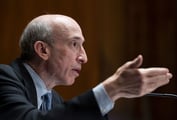
At a meeting of the SEC Investor Advisory Committee, SEC Chair Gensler says many digital tokens are securities and fall under its jurisdiction, while Commissioner Peirce says agency is applying 'strategic ambiguity' to pursue enforcement first.
Rep. Patrick McHenry, R-N.C., argues that Gensler’s appeal to Congress for jurisdiction over cryptocurrency regulation is a 'power grab.'

The Massachusetts lawmaker expressed concern that digital-asset markets lack the same investor protections as the New York Stock Exchange and Nasdaq.
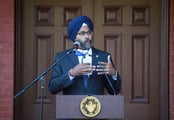
Before becoming New Jersey's attorney general in 2018, Gurbir Grewal served as a federal prosecutor leading a unit that investigated white-collar crime.
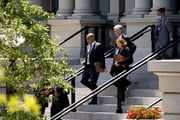
At a meeting at the White House Monday, regulators including Fed Chairman Jerome Powell and SEC Chairman Gary Gensler reassured the president that the financial system is doing well.

The responses of other federal agencies concerned about developments in securities markets may conflict with the SEC's core missions.

The SEC chair deftly handled four hours of questioning from lawmakers, including a query about Reg BI. He showed he’s a deft politician who will be able to guide policy in a direction he favors.

In his first appearance on Capitol Hill since being confirmed as SEC chair, Gensler also addressed ESG and the gamification of investing.
His slim Senate confirmation margin reflects GOP concerns about the aggressive approach Gensler has signaled on issues like expanding corporate disclosures related to environmental, social and governance factors.
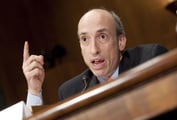
Wall Street's new sheriff will confront a range of market threats, from the fallout from the GameStop trading frenzy to the deluge of SPACs and the collapse of Archegos.

Dan Berkovitz, a Democratic commissioner on the Commodity Futures Trading Commission, blasted his own agency for taking too light a touch with the investment funds.

The central bank wants to look at the dangers that a warming planet poses to the financial system.

Sen. Patrick Toomey, R-Pa., the highest-ranking Republican on the Senate Banking Committee, takes aim at the Fed, SEC for 'mission creep.'

The panel voted 14-10 to advance Gary Gensler’s nomination to head the Securities and Exchange Commission to the Senate floor for a confirmation vote by the full chamber.
